MintScript Learn
Trade Management: Stop Giving the Plan a New Personality
Breakeven, partials, and trails only work if you wrote them before entry. Manage the template — don’t renegotiate with every red candle.
Plan the management before the position exists You enter from a 1H setup, watch a red 1-minute candle, and suddenly the whole idea looks wrong. Or price reaches your objective and you decide the trade is now a swing because you want more.
That’s a change of plan. Sometimes new information justifies a change, but it should be something you can describe and test. Anxiety alone doesn’t create a structural signal.
Choose one management template for a practice sample. Record the rules before entry, then compare alternatives on the same trade paths without pretending you could know the best one in advance.
Breakeven has a cost Moving a stop to entry removes some price exposure if it fills as intended. It doesn’t make the trade risk-free: fees, slippage, and gaps remain. It can also stop you out during a normal retest before the original target is reached.
A time-based or 1R breakeven rule is easy to apply. A structural rule, such as trailing beneath a confirmed higher low, responds to price differently. Neither is automatically superior. Compare how often each saves a full loss and how often it cuts a later winner.
Don’t describe a stop at entry as a guaranteed zero-loss trade. Check the actual exit and net P&L.
Partials change the payoff Synthetic example: initial entry 100, stop 98, so initial price risk is 2. Exit half at 102 (+1R on that half), then the remaining half at 100. Gross result is +0.5R on the original full-position risk.
If the second half instead reaches 106 (+3R on that half), the full-position result is 0.5 × 1 + 0.5 × 3 = +2R before costs. Taking partials doesn’t always increase profit. It exchanges some upside for a different distribution of outcomes.
Always weight each exit by the fraction of the original size it closes. Don’t add +1R and +3R and call that trade +4R.
Trail the structure you actually chose For a long, one example is trailing beneath confirmed higher lows on the execution timeframe. A pivot with two right-side confirmation candles isn’t known until those candles close. Backtests must respect that delay.
Trailing on a smaller timeframe is likely to behave differently from managing the original larger setup. If you change timeframes during the trade, record a rule deviation unless the plan explicitly allows it.
A stop only tightens under this example template. Widening it after price moves against you increases risk beyond the original plan. Reducing size and changing the stop still needs an explicit risk calculation; it isn’t a loophole.
Exit when the specified reason changes Write down the trigger for an early analytical exit: for example, the setup timeframe closes back inside a failed-breakout range, or price breaks a selected management swing. Then execute according to the rule.
Your protective stop remains an order-level limit on intended exposure. Don’t remove it while waiting for a candle close to decide whether your wider thesis is wrong.
A time stop is another distinct tool. If the trade hasn’t progressed after a chosen number of bars or the session is ending, an exit rule can reduce unwanted holding time. That parameter needs testing too.
Learn what you keep giving back Log the planned exit, actual exits, net R, maximum favorable excursion, and reason for every adjustment. Compare full-target, partial-plus-breakeven, and structural-trailing templates on the same sample. Include losing trades and execution costs.
The goal isn’t to exit at the exact top. It’s to manage a repeatable setup without making a new decision every time the P&L flashes.
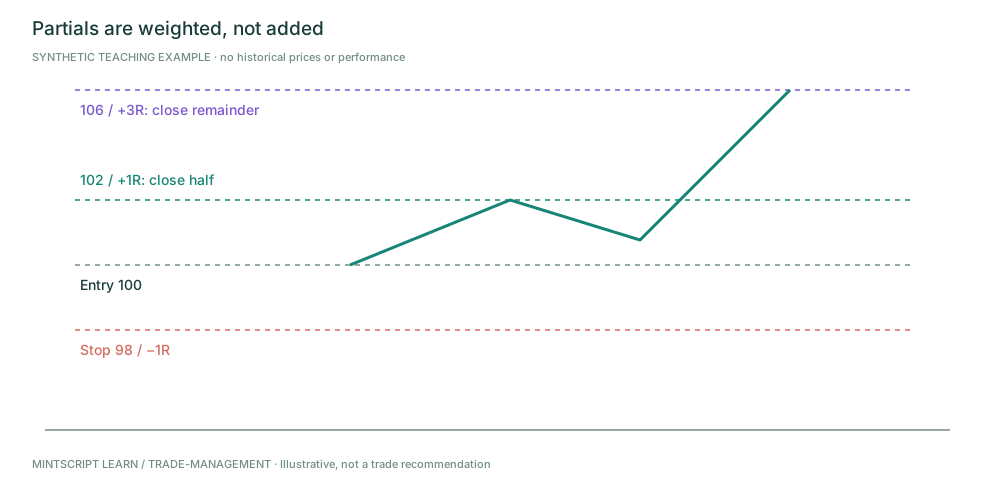
0.5 × 1R + 0.5 × 3R = 2R before costs.
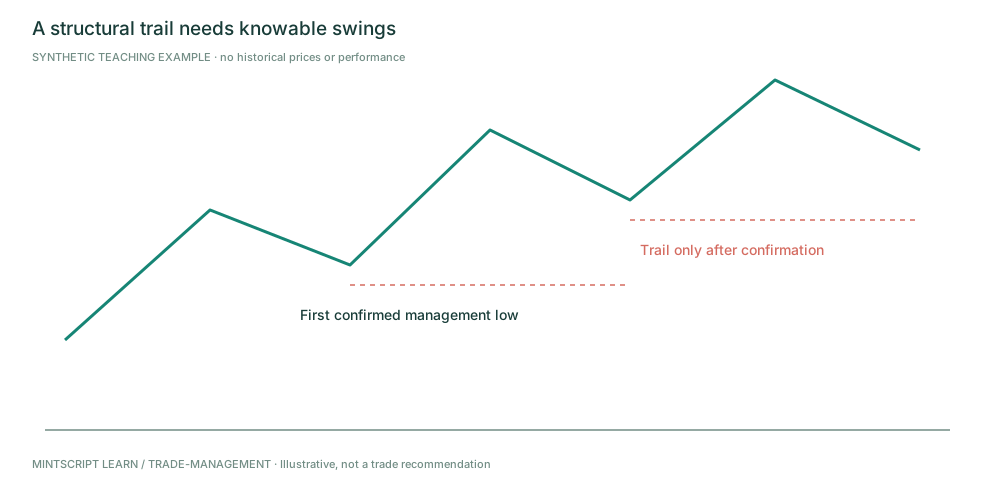
Pivot confirmation has a delay. Don't backdate the trailing stop to the low’s timestamp.
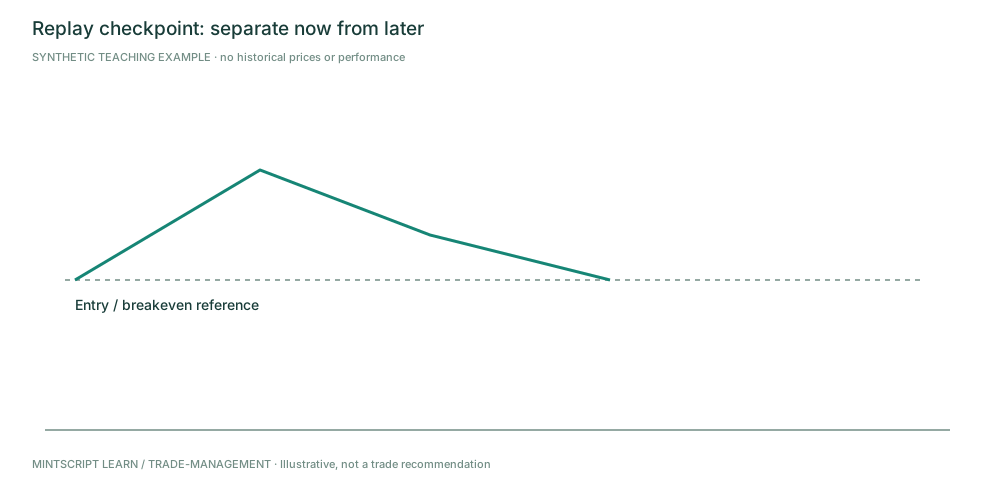
Hide the future. Describe what is known before revealing the later information.
Practice checkpoint
Half exits at +1R and half at +3R. What is the full trade’s gross result? What if the remainder exits at entry instead?
Worked answer (peek after you decide): The first path is +2R: 0.5 × 1 + 0.5 × 3. With the remainder at entry, it is +0.5R before costs. Entry-price exits can still have a net loss on that portion after costs.
Source and editorial notes
Original MintScript Learn framework. All charts and numerical examples are synthetic teaching paths — not historical trades, backtests, or performance claims. SMC / indicator labels use the explicit conventions in this lesson; they are not standardized market facts. No win rates or “institutional order” claims are asserted.
Desk features referenced: Struct · FVG · VP · Heat · Markets · ATR stops.