MintScript Learn
FVGs and IFVGs: Stop Drawing Every Gap
A fair value gap is only useful when you know what you expect it to do. Define the three-candle pattern, wait for the close, and separate pattern invalidation from your trade stop.
The rectangle isn’t the setup You can find an FVG almost anywhere after a fast move. That doesn’t mean every one deserves your money. Start with the move that created the gap, its location, and the room to the next obstacle.
A bullish fair value gap is a three-candle pattern where candle three’s low is above candle one’s high. The zone sits between those prices. For a bearish FVG, candle three’s high is below candle one’s low. Wait for the third candle to close. Before that, you have a developing pattern that can disappear.
This is a candle-based definition. The name doesn’t prove an economically fair price, an absence of trading, or an institution waiting to defend the zone.
Judge the move before the gap Ask whether the displacement broke a meaningful swing or merely crossed two tiny candles in a sideways market. Compare its body with the previous five candles. Then check whether the gap sits near a location already on your plan.
These are filters to test, not a scoring system with an established win rate. A gap created during a fast macro release can look impressive while spreads and execution are much worse than your chart suggests.
A fresh zone is simply one that price hasn’t returned to since formation. Multiple visits don’t obey a universal countdown to failure. Record visit count rather than assuming untouched means strong or touched means useless.
A clean bullish example Use synthetic candles: candle one high 100, candle three low 103. The bullish FVG is 100–103. Price advances to 110, then revisits 102.5. Under one entry model, you wait for a bullish rejection close from the zone before considering a long. Under another, you place a limit order at a predefined price. Those are different models with different fill and failure behavior.
If you wait for confirmation and price runs away without it, you didn’t miss your entry. Your entry never occurred. Don’t rewrite the trigger because the outcome looks good.
The midpoint is 101.5. Some traders call that consequent encroachment. It is a reference within the zone, not a magic defense line.
When a gap becomes an inversion candidate For this guide, a bullish FVG becomes a bearish IFVG candidate after a candle on the formation timeframe closes below its lower boundary. That’s a failed bullish zone under our convention. The bearish idea requires a retest from below and a bearish rejection trigger. It doesn’t start just because price briefly wicks below 100.
Mirror that for a bearish FVG closing above its upper boundary. Traders differ on the exact invalidation rule; choose yours and keep it consistent.
A failed gap can also be reclaimed. In our example, price closes below 100, returns into 100–103, and then closes back above 103. That weakens the bearish inversion idea. Don’t keep calling the same rectangle resistance while price is building above it.
What actually invalidates the trade? The zone boundary can define the pattern rule while a nearby swing defines the trade stop. State both. A stop at the boundary may be tighter but more vulnerable to normal movement. A stop beyond the swing may require a smaller position. Neither is automatically better.
Check the next high or low before entering. A textbook FVG with resistance immediately overhead may leave no useful trade. More confluence doesn’t create more space.
Review the failures too Log the formation timeframe, exact bounds, candle-three close time, first retest, trigger, stop, and result after costs. Include gaps that filled completely and still continued, gaps that held but never triggered, and inversions that failed. Those distinctions keep the rectangle from becoming an explanation for everything.
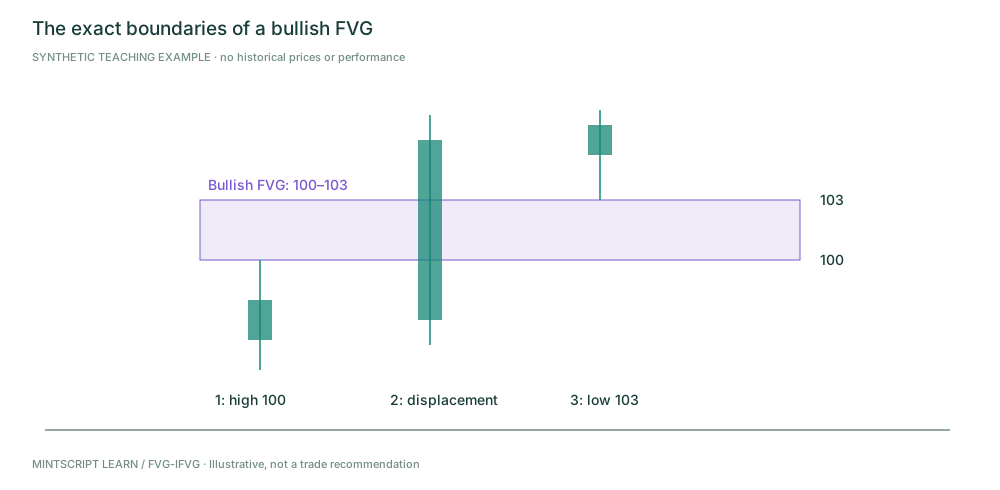
Wait for candle three to close. The zone is defined by the outer candles, not the middle candle’s body.
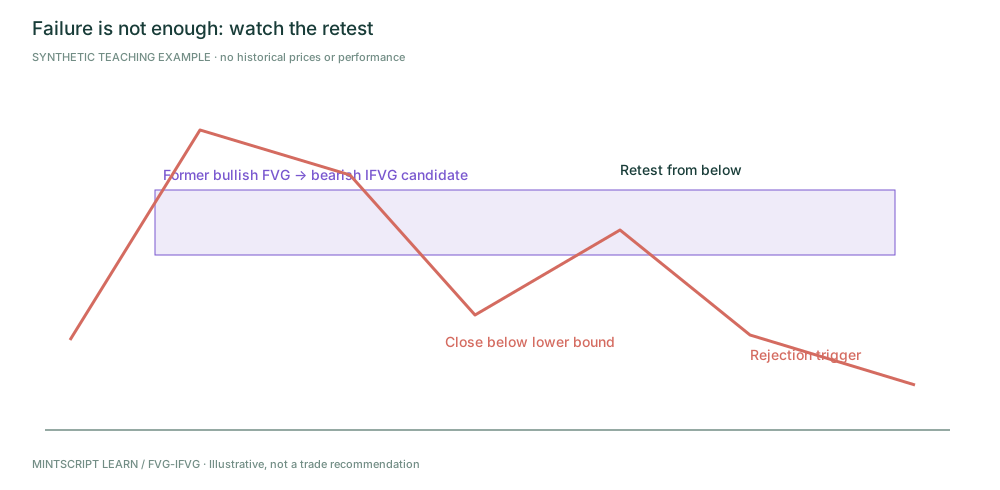
Under our convention, the close creates an inversion candidate. The retest and rejection are separate requirements.
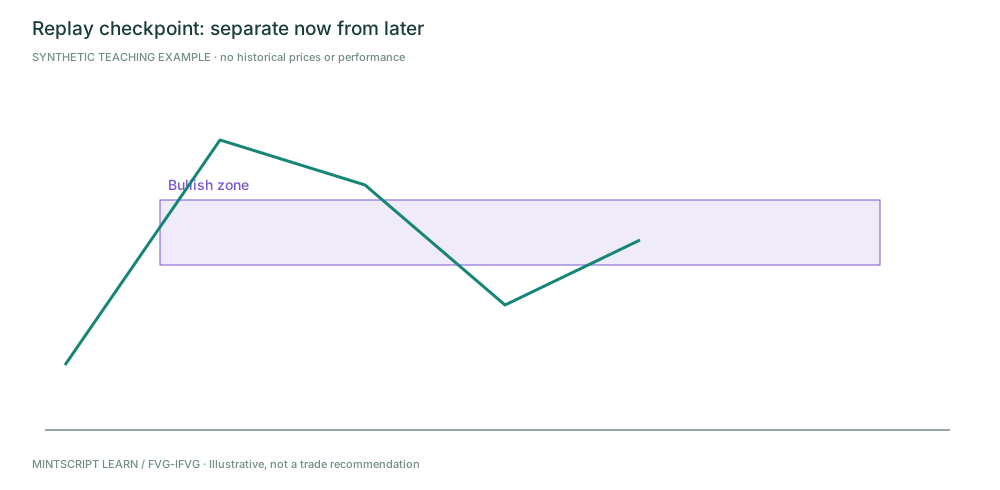
Hide the future. Describe what is known before revealing the later information.
Practice checkpoint
A bullish FVG spans 100–103. Price wicks to 99.8 but closes at 101.2. Is it a bearish IFVG under the rule in this lesson?
Worked answer (peek after you decide): No. Our inversion convention requires a formation-timeframe close below 100. A wick alone does not satisfy it. A later failed retest would still need its own trigger.
Source and editorial notes
Original MintScript Learn framework. All charts and numerical examples are synthetic teaching paths — not historical trades, backtests, or performance claims. SMC / indicator labels use the explicit conventions in this lesson; they are not standardized market facts. No win rates or “institutional order” claims are asserted.
Desk features referenced: Struct · FVG · VP · Heat · Markets · ATR stops.